Overview
What Is the Treadmill of Destruction?
In environmental sociology, a treadmill mechanism describes an expansionary process where nature is appropriated by social organizations to amass power and capital. The treadmill of destruction (ToD) refers specifically to a generative mechanism of environmental degradation driven by modern militaries and militarism. Militaries and militarism pose a unique qualitative threat to the environment when specific organizational dynamics are set in motion by geopolitics and arms races.
Historically, nation-states play a key role in the growth dynamics of militaries and militarism, where additions to and withdrawals from the environment result in environmental degradation that is not simply a derivative of economic drivers. With the proliferation of less formal military organizations, the "new wars" of the late twentieth and early twenty-first centuries have contributed to severe environmental degradation as irresponsible resource extraction and ecocide have become increasingly common.

Societal & Academic Context
Why the Military Gets Left Out
The post-WWII acceleration in carbon dioxide emissions and chemical production has received the bulk of attention in research and public discussion of the Anthropocene — an era of human-induced environmental change. This discussion has focused on the impacts of capitalist expansion and corporate profit-seeking, with far less attention given to the impacts of military institutions on the environment.
Sociologists have long debated the influence of economic and military power in shaping political economy. Building on C. Wright Mills's power elite framework, ToD theory highlights the autonomy of the state in its capacity to wage war and monopolize organized violence — a dimension of institutional power that economic theories of environmental harm consistently understate. Since WWII, the specialization and concentration of defense production has resulted in defense firms acting as client firms of the Pentagon, with subservience to the goals of defense planners being the rule.
Nuclear Fallout as an Anthropocene Marker
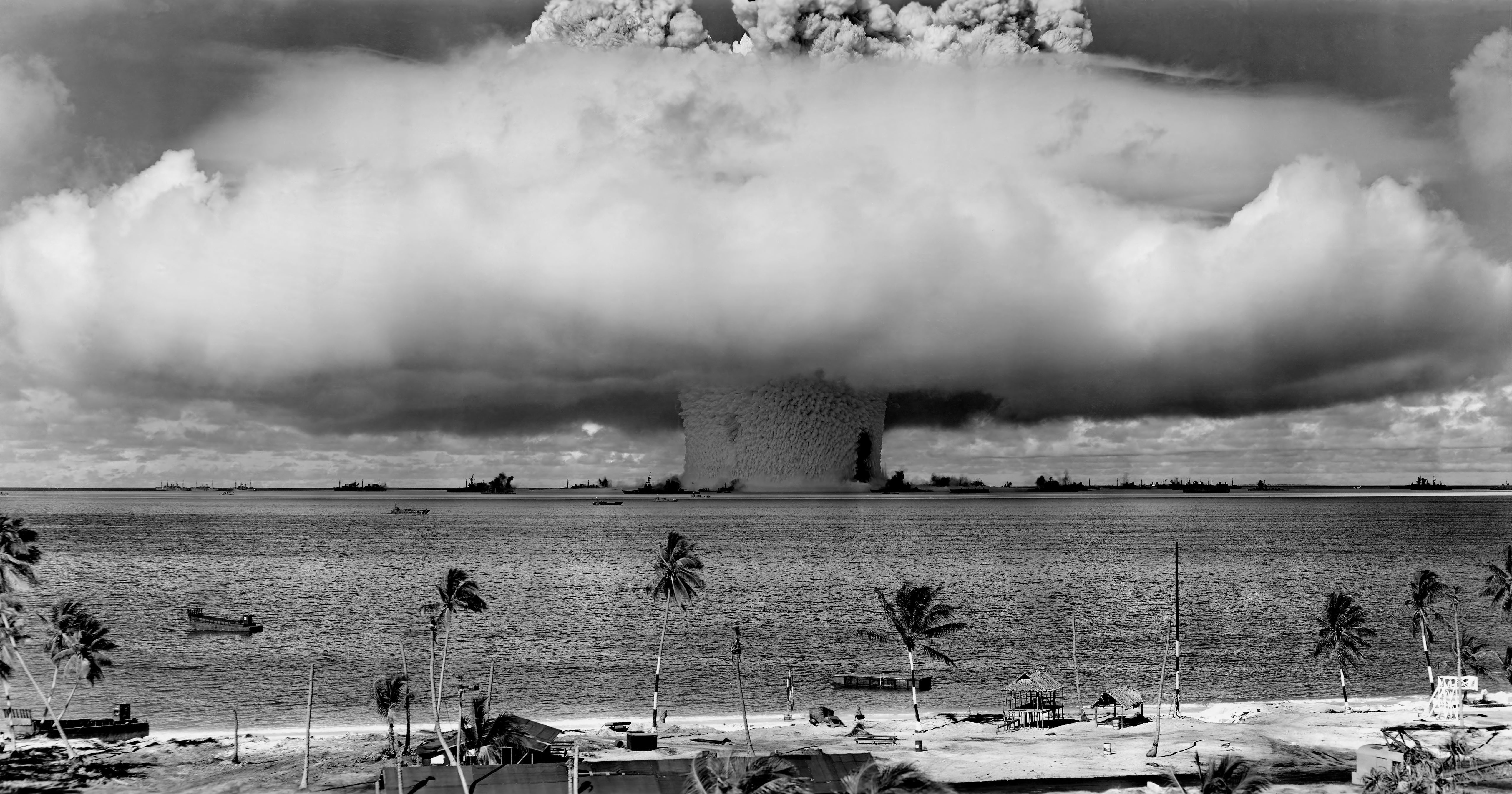
Scholars have argued that nuclear fallout from weapons testing is one of the most convincing stratigraphic markers of the Anthropocene — the geological epoch defined by human transformation of the planet. Nuclear weapons and technologies have limited civilian application, yet their creation and testing have virtually changed the face of planet Earth. Their existence is explicitly tethered to national security and geopolitics, not the corporate pursuit of profit or market shares (Waters et al. 2015; Zalasiewicz et al. 2015, 2017).
Empirical Record
What the Research Shows
National Sacrifice Zones & Native Americans
The seminal work in the ToD tradition examines the U.S. military's relationship with environmental inequality and its impact on Native Americans. The 18th- and 19th-century conquest and genocide of Native Americans concentrated Indigenous populations in Western states, while the 20th-century emergence of the Pentagon — and the acceleration of technologically sophisticated and resource-intensive warmaking — led to the "national sacrifices" and toxic contamination of the very lands on which Indigenous populations had been forcibly resettled.
Historical coercion, geopolitics, and arms races thus give the treadmill of destruction distinctive expansionary characteristics that are institutionally distinct from capitalism but reinforced by the same racial and colonial structures that organized Indigenous dispossession.

Cross-National Quantitative Evidence
A substantial body of quantitative cross-national panel research confirms the ToD's predictions. This work explored novel means of measuring the treadmill by demonstrating how military spending per soldier — capturing high-tech, capital-intensive military power — and military spending per capita provide important perspectives into how the ToD influences environmental outcomes apart from the destructive power of shooting wars:
- Military expenditures per soldier significantly drive carbon emissions in both developed and lesser developed countries — positive in the developed world, negative in the periphery, reflecting ecologically unequal exchange
- National militaries were a central structural driver of freshwater withdrawals globally between 1997 and 2001, while several major economic variables proved non-significant
- The impact of militarization on carbon emissions intensified after the 1990s — coinciding with the Revolution in Military Affairs and the shift toward high-tech, resource-intensive "risk-transfer militarism"
- Demilitarization in former Soviet Republics after the Cold War was associated with significant reductions in carbon emissions — confirming the environmental consequences of the ToD in reverse
"The dynamics of militarized production and preparation for war — not the fighting of war itself — is linked with significant and enduring environmental injustice."
Outlook
New Theoretical Directions
Updated theorizing on the ToD focuses on theoretical mechanisms and treats treadmills as idiosyncratic in terms of the historical and socio-cultural contexts that lead to their emergence, acceleration, and demise. Treadmills are also dynamic and malleable — multiple treadmills can exist simultaneously and become synergistic.
This logic extends from research demonstrating the multitude of armed groups that mobilize violence and wage war in contemporary times. In the context of the Colombian Civil War, for example, the confluence of treadmills of production and destruction — narcotraffickers, paramilitaries, state forces, and coca eradication campaigns — generated severe human and environmental health consequences in some of the world's most ecologically sensitive areas.
Future research should examine the broad range of contexts in which large-scale organized violence leads to organizational dynamics that drive harmful environmental practices. Explicit attention to the conditions which facilitate the emergence, transformation, and demise of treadmill mechanisms has direct implications for domestic policy agendas and global geopolitical aspirations — particularly as climate change generates new resource conflicts and military buildups in ecologically sensitive regions like the Arctic.


